Showing posts with label Zoology. Show all posts

Thursday, August 22, 2013

Predators and Prey

There is are the predators, and there are the prey.
Predators - an animal that eats another animal.
Prey - the animal that is eaten.

Here is an example of a food chain:
Plants>Rabbit>Tiger (>People)
Here is a regal tiger.

Monday, May 6, 2013

Zoology 1: Flying Creatures of the Fifth Day


I have just finished Zoology 1: Flying Creatures of the Fifth Day! It is a great book, and is where I have been posting from mostly - anything under my label Zoology is form this book.
In my opinion, it is fit for 3rd - 8th graders.

Friday, May 3, 2013

Silk Cocoons

One day a royal Chinese girl was having tea in a garden. Then, suddenly, a moth cocoon fell into her tea from the overhanging branch of a tree. She asked her maid who was with her to hold the cocoon, and the Chinese girl took a bit of the unraveled cocoon and went around and around and around the garden, unraveling the cocoon around the trees in bordering corner the walls of the garden. She went around many time before she ran out of string. Then, she had the light, soft material spun into string and finally made into the most softest, lightest clothing of that time.
--------------------------------------------------------------------------------------------
Thousands of years ago, anyone who knew the secret of the silk moth or was suspected of knowing it would be immediately beheaded. Only the Emperor's family knew, and the secret was passed on down for generations. This made China one of the richest countries. Back then, the silk was very expensive, and only rich people had silken clothing.
But, then monks smuggled some silk moths (as the moth came to earn its name) out in their canes, and the secret was revealed to the world.
Now, silk makers keep moths and mate them, and when they go into their offspring go into the cocoon stage they put the cocoons into a pot of boiling water, sacrificing the soon-to-be moth. Then he makes silk out of the unraveled cocoon.
Of course, if silk makers boiled all of the cocoons, they we wouldn't have any silk butterflies left in the world and therefor there would be no more silk. Because of this, silk makers don't boil all of the cocoons, and when the moths come out and then mate, the process soon starts all over again.
Now silk is expensive, but it can be bought by the average person now (for a price), not only rich people. Why is silk so expensive? Well, to make one silk tie, it takes one hundred silk cocoons - that's one hundred moths.

Five silk cocoons.

Fun fact! Moths have, over the thousands of years, lost the ability to fly because silk makers feed them the necessary food - mulberry leaves - for them to make silken cocoons. Therefor, silk moths have had no reason to fly (silk makers like that the moths don't try to escape). 
If a silk moth somehow did get into the wild, it wouldn't survive long.

Thursday, May 2, 2013

Scientific Words about Leps

Leps are mainly butterflies, moths, and skippers ('caterpillar words' refer to baby/young leps)! 
Some of these words aren't only used for leps.


Here are some scientific lep words!
egg - the case in larvae develop
legs/true legs - the six legs attached to a caterpillar's thorax
prolegs -  the 'legs' (which are not legs; they just look sort of like them) attached to the caterpillar's abdomen, used mainly for moving from here to there and keeping a grip on whatever the caterpillar is hanging on
crochets - the little 'hooks' and the end of a proleg that help the caterpillar to have a good grip on whatever surface if is hanging on
molt - when a caterpillar sheds it's skin because it is too small
instar - the period between one molt and another
cocoon/chrysalis - the case in which a caterpillar develops into a lep
antennae - the 'feelers' a butterfly has on its head

Wednesday, May 1, 2013

Butterfly Migration

Most butterflies just live in the same place for their whole lives, from caterpillars to adults. But the Monarch Butterfly is a completely different story.
Dr. Fred Urquhart of the University of Toronto discovered that Monarch Butterflies migrated by noticing that they always left his area at a certain time in the fall, and then came back the next year. He decided to do an experiment, and put little tags on all the Monarch Butterflies he could, asking if the unknown recipient would send back the butterfly to his address (he also included his name). Those tags must've been tiny!
Anyways, he got butterflies back from all of the United States - but the furthest results were in Mexico. So, he went there and asked lots of people if they had seen some Monarch Butterflies. This took years, but, eventually, somebody told him about a place where huge groups of butterflies would gather. Dr. Urquhart went there, and sure enough, there were butterflies on butterflies on butterflies all about him - hanging on trees, hanging on each other...and all of them were hibernating! There were so many that wherever you looked, there were butterflies.
Fred made a truly great discovery about the Monarch Butterfly.

Monarch Butterflies do migrate back - not all of them survive the journey to Central Mexico (where they gather for hibernation) or back to the United States, but on the way back, they lay eggs all over the place, so if they don't survive, their offspring will.

A large group of Monarch Butterflies clinging to a tree.

Tuesday, April 30, 2013

Quiz Time!

Q. What are the three main species of leps?
A. Butterflies, moths, and skippers.

Q. Which of these leps seems 'skip' along when it is flying?
a) butterflies
b) moths
c) skippers
A. c) skippers

Q. Which of these leps tends to hover in front of a flower when using its proboscis to drink nectar?
a) butterflies
b) moths
c) skippers
A. b) moths

Q. Which of these leps have feather-like antennae?
a) butterflies
b) moths
c) skippers
A. b) moths

Q. Which of these species leps has a lep that is commonly seen in North America, but tastes bad to animals if eaten?
a) butterflies
b)  moths
c) skippers
A. a) butterflies

Monday, April 29, 2013

The Antennae of Leps

Different types of leps (flying insects with scaly wings - the scales are really tiny, so they look like a powder if you rub them off of a wing) are distinguished from each other by many different factors, one of which is the shape of their antennae. Antennae are at the top of an insect's head, and are used for the senses of touch and smell.

Butterflies'  antennae are shaped like thin poles with nubs at the top.
 
Moths' antennae are feathery-like.
 
 
Skippers' antennae are shaped like long poles that curve at the end slightly so that they look like J's.

Friday, April 26, 2013

Cicadas

Cicadas are the LOUDEST insects - they're buzzing can be heard 400 yards away! For an insect usually 1 - 2 inches long? That's what I call buzzing. Only males buzz though.
So about once a year, the cicadas will mate - the nymph stage lasts for a year, and then they hatch and live as adults for a few weeks. These cicadas are called dog-day cicadas or annual cicadas.
Here is one of the 13/17 year cicadas.
But some cicadas live as  nymphs for 13 or 17 years, and then, all of them come out of the ground (one the male and female mate, they will lay their eggs in a slit in a tree which the female makes with her oviposter, and then when the eggs hatch the newborn nymphs drop to the ground due to their instinct, where they live off of the sap in tree roots) all at once! Could those creatures learn to do that out of many generations by evolving? NO WAY! Only a Creator - God - could have made such an amazing thing.

Wow, those cicadas sure must cause a racket when they come out of the ground. During that time, it's bird (and other animals/insects) feasting time...easy pickings for everyone!

Thursday, April 25, 2013

Aphids

Aphids are little insects...and they are pests to most farmers.
Why are they such pests? While, they destroy crops by eating them. And they eat a LOT. In a field, there could be up to FOUR TONS of aphids - who are as large as or smaller than ants.
That's why lots of farmers by predators of aphids, such as lady bugs (the aphids' most dangerous predator), to put in the crops and eat any pests.
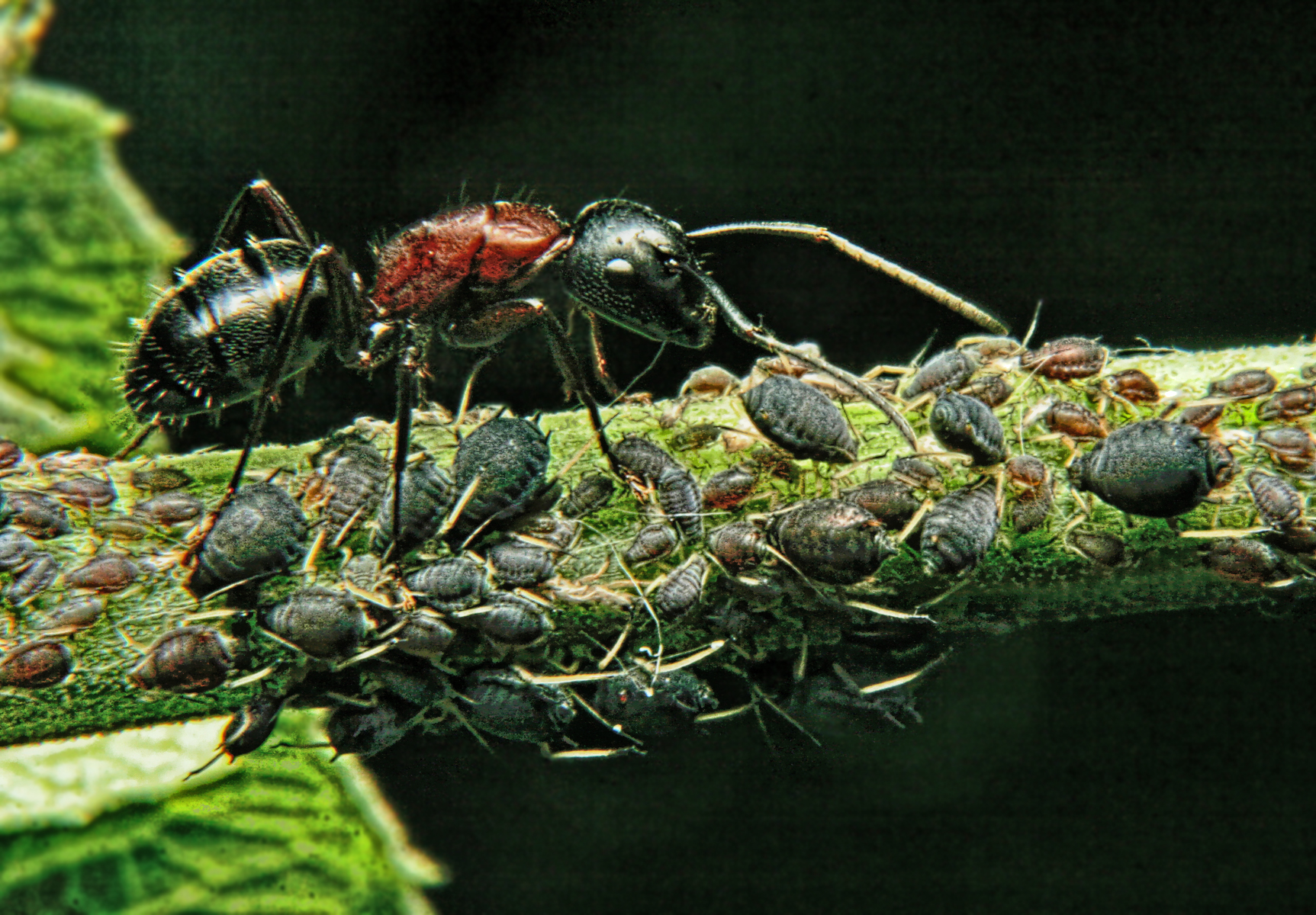
Ants will actually look after aphids sometimes, because then if they gently rub them, a small, tasty (at least to ants) drop of liquid called honeydew will come out of the aphid's abodomen - then the ant can enjoy a moment of sweetness.
An ant attending its 'herd' of aphids
If there are too many aphids in one colony (that's not too hard to imagine), then instead of laying wingless aphid eggs, the aphids will lay winged aphid eggs, so that when the winged aphid hatches, it can fly away to start its own colony.


Wednesday, April 24, 2013

Parasitic Flies

There are parasitic flies - and they are true parasites of the insect world. Two types of fly will actually lay their eggs in an insect, and when the egg hatches, the little fly larvae lives off of the poor insect's innards. Don't worry - flies may be able to spread diseases, but no fly eggs will be lay in you.
So, how do insects avoid this? While, first they can be camouflaged; like the katydid is shaped and colored like a leaf.
Also, they can jump away; like the grasshopper with its powerful back legs.
Or they can fly away; like butterflies.

Tuesday, April 23, 2013

Grasshopper Eardrums

Grasshoppers can hear - they use a pair of small eardrums, and for most species of grasshoppers, it they are located near the top of the abdomen and above in front of the hind legs.
So can grasshoppers actually hear, though? What's the proof - they've got an eardrum, yes, but what about the ear? Well, grasshoppers use the eardrum by 'listening' to the vibrations from sound waves. An ear (like the ones humans have) is used more for capturing sound so that we can hear better.

Below is a grasshopper's eardrum.

The highlighted semi-circle is this grasshopper's eardrum, as shown here.

Friday, April 19, 2013

Praying Mantises

Praying mantises are actually preying mantises - they got their name because it looks like they are "praying" with their folded over "hands". They are more like preying mantises because they are near the top of the food chain in the insect world.
They hunt by sitting on a leaf or something like that (their color camouflages them a bit), being absolutely still. They wait. And wait. And wait...okay, I think you get the point. Then, when a tasty (and unsuspecting) morsel comes along, the praying mantis grabs it and eats it.
Praying mantises can eat almost anything smaller than it - that includes butterflies, caterpillars...even small frogs or salamanders!

Wednesday, April 17, 2013

Robber Flies

Robber flies are flies that resemble bees or wasps. Because of that, they can easily hide themselves outside of a bee hive and catch a bee to eat that's going in or out of the hive. How does he catch his prey? Well, he grabs hold of it with bristle-like hairs on his legs and injects a poison inside of the insect. Then, the poison will turn all of the bug's innards (like its stomach, etc.) into a liquid, which it feasts upon.
Robber flies can actually kill dragon flies by using this unique method.

Here is a robber fly feasting on the innards of its prey.

Tuesday, April 16, 2013

Flies: Pests or Helpers?

Flies help the community by doing the stuff in blue at some stage in their life.
Flies are pests by doing the stuff in green at some stage in their life.
Helpers!
  • Eating aphids, who ruin farmers' crops.
  • Eating slugs, who also ruin farmer's crops.
Pests.
  • Spreading lots of germs  

Saturday, April 13, 2013

Math Problem #10


Q. Bill the killer whale was wondering why he was called a killer since he didn't kill humans, and why they called him a whale since he was technically in the dolphin family. He spent 2 1/6 days thinking about it, and finally came up with an answer (which wasn't truly proficient): "Humans think I can kill the waves like a whale!" How many hours did it take Billy to find an answer?
A. (left click and scroll over white line) 52 hours

Thursday, April 11, 2013

Ladybugs

Ladybugs are not actually bugs - they are beetles. So, in this post, I'll call them "lady beetles".
Lady beetles can be red, orange, or yellow; with black spots on any of those colors.
Their larvae look like strange adult insects; black, prickly things with some orange stripes on them.


A lady beetle's abdomen is bellow its wings; and it has a collar-like piece of its shell before it's head. You can see that in the below diagram.

Tuesday, April 9, 2013

Fireflies

Fireflies are amazing little creatures. These insects can create a light using way less energy than a light bulb, and by doing it, use way less heat than a light bulb. That means fireflies make a cold light. If fireflies were electric light bulbs in your house, you would save a lot of money when you used lights.
So, how do fireflies part of their abdomen glow? Well, they naturally mix two chemicals together, which makes a glow.
What do fireflies use their light for? Below, I've listed the three reasons:
  • attracting a mate
  • warning others of danger
  • warning whatever is dangerous to stay away

Here is a firefly with its abdomen lit up.

Monday, April 8, 2013

Dung Beetles

Dung beetles are in the Scarab Beetle family. Although their feeding habits (eating other animals' dung) may seem disgusting, they are actually very helpful. Dung beetles are actually transported to some places that have lots of dung.
So how does a dung beetle's 3-5 year life start? Well, one of the parents finds dung and roles it into a ball, which can be up to 50 times heavier than he/she is!
Then, the beetle roles the dung to its home, a hole in the ground, and the female will lay eggs into it. Since both the larvae and adults love feeding on dung, the mother will bury the several balls of dung with eggs in them by pushing dirt over them, and some dung too. Then, when the eggs hatch, the larvae can eat as much as they want! They transform from larvae to pupae, and then to adults, which is when they climb out of their little hole and scavenge for their own food.
Dung beetles can be found pretty much anywhere there is dung - which is nearly everywhere (except for the oceans and such, because dung beetles can't survive under water).

Thursday, April 4, 2013

Bumblebees

Bumblebees are similar to honeybees, but are different in many ways.
First of all, they look different. They're more bigger and more "fluffy" in appearance.
A honeybee.
A bumblebee.

Second, when they sting, since their stingers are barbed, they can sting again and again, though they usually don't sting in as great numbers as honeybees do, and seldom do so more than once.
Last of all, their hive is coordinated like a honeybee's, but a lot less organized. One thing that makes it less like a "professional" hive is that, unlike honeybees, bumblebees don't send out scouts to go and look for flowers and such. The workers just go out and look for it themselves.

Wednesday, April 3, 2013

Wasps

Wasps are probably the most feared insect - they are the most "vicious" in my opinion, as far as I know (I don't know if there is another more harmful insect or not...please comment if you know one!).
They have an especially long ovipositor (stinger) compared to bees. Their abdomen is connected by a long petitole to their thorax.
Wasps are more dangerous than bees because, unlike most other flying insects that sting, they can stab and stab again their ovipositor into their victim. When a bee stings, however, it can only sting once because when it tries to yank its ovipositor out again, it succeeds in dislodging itself from its target, but looses its ovipositor and some of its abdomen in the process, which makes it die a little while later.
That makes it so that wasps live longer than bees usually.